
Strike Zone
Working for the Evil Empire

In baseball, a skill known as “framing” is highly prized. It is a sleight-of-hand magic trick where a Catcher makes a ball appear to be a strike. The video below is sixteen minutes long, and it shows hundreds of pitches from the 2024 season that were not in the strike zone but were called strikes by the umpire because of the framing skills of the SF Giants catcher Patrick Bailey, who won the Gold Glove that year.
Take a moment to observe the magic. You can watch the whole thing (I have, more than once, but I’m a hopeless geek) or just a few pitches. It’s truly remarkable what Bailey does.
In 2026, Major League Baseball (MLB) is expected to introduce a new technology called Automated Ball & Strike (ABS), also known as “robo-umps.” To some extent, ABS will devalue the framing skills of catchers like Bailey. The technology can’t be persuaded by glove movement; it observes the baseball’s exact position as it passes over the plate, before it gets to the catcher’s glove.
What do I know about robo-umps? I’m glad you asked.

I retired from full-time work in the Summer of 2019. After keeping my head down and getting through the COVID kerfuffle, I was unsure what retirement would look like.
I am an avid fan of baseball. I spent a fair amount of my newfound spare time watching my beloved San Francisco Giants—every game, whether home or away, was broadcast on a channel included in my cable package.
In 2021, the year after the shortened COVID season, the Giants gifted me an unbelievable season. They won a franchise record 107 times, topping the hated Dodgers by a single game and interrupting a long string of Los Angeles NL West championships. The race for the division title was decided on the last day of the season, and it was glorious.
Before the next season started, I read an article about how ABS technology was coming to AAA minor league baseball, the level just below the majors. The article included an email address and stated that they were seeking individuals to hire and assist with the rollout.
My professional background was in software and technology. The town where I lived had a AAA ballclub. I love baseball, and I had time. I sent an email, completed an online application, went through a couple of Zoom interviews, and got the gig.
What a coup! I was being paid by Major League Baseball (MLB) to watch live baseball from a seat right over the third-base dugout—seats that would have cost me over $1,000 to purchase as a fan.
I was paired with another new MLB employee, and we split up the home games. My partner was a younger guy, and he joked that he had always considered himself a Rebel Alliance kind of guy and that working for the Empire would be “interesting.”

I thought that my background working with a heavyweight Silicon Valley company before retiring would allow me to be especially helpful in this new role. My daughter informed me this was not how the real world worked; my years in the Silicon Valley cocoon had given me a warped sense of actual employee/management dynamics.
It’s taken time, but I am finally getting used to my daughter being wiser than I am about most things in the real world.
My job was essentially that of a pack mule. I delivered equipment before the game, picked it up after, and plugged it in to recharge the batteries before the next day’s game. During the game, I monitored the equipment to ensure it was not malfunctioning. It failed only once, when an umpire pulled on his earpiece and yanked out a wire. I went onto the field and gave him mine. That was my moment in the sun.
I interacted with the umpire crew every game. That was fun, and I learned a lot just by talking baseball with them. But it was also apparent that they did not trust me. I was a representative of the Empire, peddling technology that they saw as a threat to their profession. I may as well have been wearing Star Wars armor and breathing into a microphone.
They were friendly but extremely guarded. They thought the whole ABS project was unnecessary but inevitable, but they would not say that out loud in front of me. Major League Baseball employed me. It was safest not to trust me with their actual thoughts.
When I reported to management that teams had questions, the Empire told me there were “well-understood avenues” for them to send inquiries, and I was asked not to short-circuit that process. When I pointed out fundamental problems with the software on iPads in the dugouts, I was told that my thoughts would be logged and considered.
I was no longer in the cocoon. My management pretended to care about what I thought, but it was all song and dance. Decisions had been made, the train was rolling, and nothing was going to slow it down. ABS would be in the Major Leagues soon. Feedback and iteration would only slow things down.
Empire’s gonna empire. MLB is actually a legal monopoly. They don’t care. They don’t have to.
I committed to a season, and I did my time. When the year ended, I thanked my boss and said I would not be returning. He seemed genuinely sorry to see me go. Thus ended my brief career with Major League Baseball.
The most important thing I learned from my summer of being paid to watch live baseball was that if you have a job, you ain’t retired. If you have to be somewhere at a specific time and find that your input is tolerated rather than encouraged, that is pretty much the definition of a job for most people.

Stop reading now if you are not an incredible baseball nerd. I was only able to make the first half of this post readable by avoiding the temptation to work the stuff below into the main narrative.
Hawkeye
The technology that enables ABS is Hawkeye. It consists of cameras situated around the ballpark, all pointed at home plate, and a computer system that monitors all of the video feeds. Once fully calibrated, the computer can determine the ball's exact location within space by triangulating the feeds.
Hawkeye does not power the image defining the strike zone you see on your television screen. That is much more primitive. Among other things, Hawkeye is looking at the ball’s location relative to the plate in three dimensions.
If you are a tennis fan, you have seen Hawkeye in action. Rulings on whether a ball is in or out of bounds at Wimbledon are determined by Hawkeye technology.
Size of the Strike Zone
The plate in baseball is seventeen inches wide. If any part of the ball passes over the plate, it is a strike as long as it is not too high or too low.
The bottom of the zone is defined as “just below the kneecaps” at the bottom and “the midpoint between a batter's shoulders and the top of the uniform pants” at the top. If you think that leaves a lot of room for interpretation, you are correct.
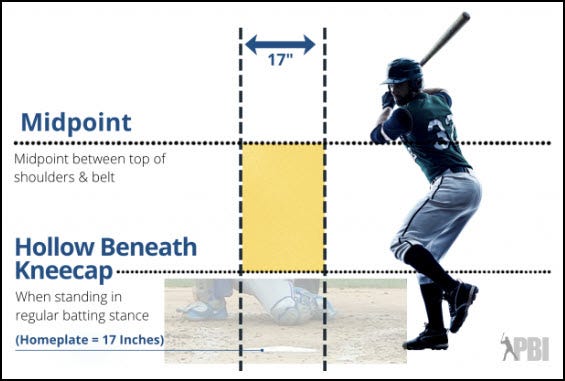
As far as the ABS zone goes, in AAA baseball, the top and bottom of the zone were determined by taking a player’s height and then using math. I don’t recall the exact numbers, but it was something like 26% of the height was the bottom of the zone, and 61% of the height was the top.
Of course, there are many different body types. Not everyone’s knees are at exactly 26% of their height. Players had to figure out what the system considered a strike.
I was told that when the system reaches the major leagues, each player will be individually evaluated, and their unique numbers will be stored in a comprehensive database for the ABS system.
The ABS Strike
One term of derision I heard from the umpires I worked with at AAA games was the “ABS Strike.” This takes a bit of explanation.
Before every pitch, the catcher sets a target for the pitcher. It could be a quick flash of an open glove, or it could be holding the glove steady in one spot. Combined with other signals, it tells the pitcher the plan of attack. Fastball at the top of the zone. Slider inside at the knees. Curveball outside of the zone.
If the pitcher misses the target by much more than a few inches, that pitch might be called a ball regardless of whether the ball is in the strike zone. If the pitcher misses the target so badly that the catcher has to lunge to keep the ball from getting past him, that’s going to be a ball 100% of the time. He missed the target badly. That’s never a strike.
Except that ABS doesn’t care about any of that. If the catcher sets a target at the top of the zone on the inside corner, and instead, the ball nicks the lower outside corner and skips to the backstop, ABS will call that a strike. It was over the plate at the knees. Strike.
The “ABS strike.” It was the biggest complaint I heard from umpires. They felt that it rewarded bad pitching.
The Tightening Zone
Before this year, umpires were evaluated on their strike calls based on the zone defined above, with up to two inches of “fudge” on all sides. So if an umpire called a strike and the baseball was actually off the plate by 1-1/2 inches, that was considered a “good call.” If the baseball was an inch above the knees and called a ball, that also was not a mark against the umpire.
Umpires famously have different zones, and a part of becoming a successful major league ballplayer has been learning each umpire’s tendencies and adjusting your approach to account for them. If umpire Bill Jones calls a lot of strikes that are outside to right-handed batters, the pitchers take advantage and the batters have to protect against the generous outside strikes.
This season (2025), MLB quietly changed the rules, reducing the fudge factor from two inches to just three-quarters of an inch. If umpire Bill Jones continues to give pitchers that outside strike, he will be dinged on his evaluations. The result is that umpires have all tightened up their zones, and balls and strikes are being called much more consistently.
I strongly suspect that this change was in anticipation of the introduction of ABS next season. Having the umpires and ABS closer to each other in their judgment will make the transition much smoother.
Full ABS Versus the Challenge System
When I worked AAA games in 2022, it was full ABS. Calling balls and strikes was taken entirely out of the umpires’ hands. They had an earpiece, and less than a second after the ball passed over the plate, the ABS system would broadcast either “Strike” or “Ball” into that earpiece. To the casual fan, it seemed like the same as ever. The ball popped into the catcher’s mitt, and the umpire made the call.
In truth, with full ABS, you could probably train a Border Collie to call balls and strikes. Umpires predictably hated it, but there was no choice. They had to do as they were told. I had backup equipment and listened on the same earpiece, and over the course of the season, I never once saw an umpire contradict the ABS call.
One advantage was that the players quickly learned that arguing a call was more pointless than ever. Everyone knew what was happening. The umpire would just shrug his shoulders. “Just following orders, brother.”
Toward the end of the 2022 season, some AAA games switched over to the “ABS Challenge” system. In these games, the umpires would call balls and strikes as they had always done (without using an earpiece). If the batter, the catcher, or the pitcher felt that the umpire got the call wrong, they could challenge (it must be immediate, within seconds of the call, and the challenge could not come from the manager in the dugout).
The game is paused momentarily, and a graphic representation of the pitch is shown on the scoreboard where everyone (including the fans) can see the ABS-delivered verdict. If the challenge is upheld, the umpire’s call is reversed. If the challenger is wrong, they lose an opportunity to challenge later in the game.
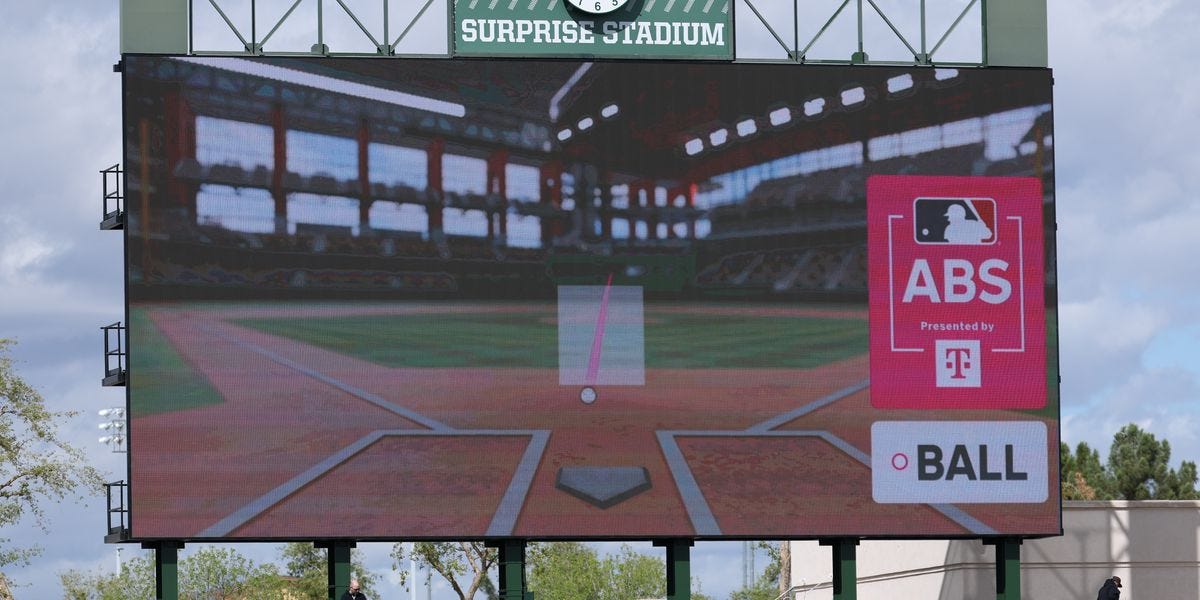
It’s a good system. It takes literally seconds to resolve a dispute, and everyone will have more confidence in the calls being made. It also adds a new element for fans to engage with.
The challenge system is set to take effect next year in the major leagues. Each team will be given two challenges for the game. If you lose them both (challenge and don't get a reversal on the call), you can’t challenge any more times in that game.
Angel Hernandez
I want to end with another video from the archive of the greatest baseball hits. Angel Hernandez was a Major League umpire who famously called strikes that were off the plate. I mentioned above that umpires were evaluated on whether they were accurate to within two inches. A baseball is about three inches in diameter. You tell me, are any of these pitches less than two inches outside?
Three called strikes in a row.
This kind of work is incredibly damaging to baseball. Hernandez was forced out of the game later in the season. It could be argued that Angel Hernandez is the reason ABS became inevitable.
ABS challenge system in 2026. Play ball!
This is excellent! Thank you for the nerd details as well as what it was like working for the Evil Empire. I had wondered how they dealt with height differences.